Whether members know it or not, there are some arguments within the physical training community, about the benefits of using unstable surfaces for hockey workouts. I barely understand the antis on this one, but it very well could be that our two camps are looking for drastically different results.
-- Dennis Chighisola
Using Unstable Surfaces For Hockey
I don't want to get into the argument right now, but I might some time down the road. What I do want to reinforce here are some of the things I see as real positives for using unstable surfaces for hockey training.
As I begin one of my older posts linked below, our game is rather chaotic, or it's kinda wild and crazy out there. That's important for all of us to keep in mind, and it's especially important for coaches, parents and adult players to apply to training. Hey, we have to practice for the way we ultimately have to play.
In my article (and in the accompanying videos) about "WBV Leads to Coach Chic’s 'WakeBoard'", I explain my thinking behind recreating on-ice conditions in The MOTION Lab. I hope you find that interesting, and I'm hoping some of my thinking might relate to your own experiences or observations.
The main idea of that WakeBoard device was to have a player move in all sorts of unbalanced postures while simultaneously tossing around a weight of some sort.
The next thing I'll want to introduce is the concept of asymmetric puckhandling, or "Handling More Than One Problem At Once". As I mention often in any posts having to do with puckhandling, passing, receiving or shooting, we hardly get to do those in nice, pretty postures. No, people are hooking, hacking and otherwise trying to kill players as they attempt to handle a puck.
When you see all the stunts I have my players try to do while puckhandling -- like skipping rope, hopping on constantly changing feet, kneeling and raising back up, or enduring bumps by a friendly teammate, that's the asymmetric thing, or trying to deal with more than one physical problem at a time.
Enter my idea of using unstable surfaces for hockey puckhandling. And also enter a video I'm borrowing from a long ago post that was actually about conditioning...
I hope you noticed the many gadgets I employed to have my players working on unstable surfaces for their hockey puckhandling. For example, I did a lot in the Lab with our mini-trampoline, and I loved the little air-pillows for tossing my players around in game-like postures.
Getting back to the original problem -- about the positives or negatives of using unstable surfaces for hockey training, I think the main argument has to do with our aims in the end. I honestly don't believe some other physical training guys are seeing hockey challenges as I am. What I'm saying is that hockey players don't get to stand much or move prettily around the ice, instead having to prepare in advance for bobbing and weaving and getting knocked all over the place. I also know that my guys have to be strong in all sorts of unbalanced positions. It would be nice if we could do something like squats in the gym in order to prepare for the hits players take out on the ice. But, while those standard exercises surely do help, they're not as specific as my WakeBoard work is to all the wrestling and tussling that happens out in the game.
This might be a rather short entry in comparison to most others. Still, it's no less important. In fact, I'd say that using deception in hockey is even more important nowadays than it ever has been before.
-- Dennis Chighisola
Using Deception In Hockey
When I think about using deception in hockey, three main areas come to mind right off the bat.
The first on my list involves some foolery on breakouts...
I have a feeling that every member agrees with the idea that the so-called "first pass" on our breakout is a biggie. I mean, successfully advancing the puck up-ice -- from a defenseman to a flying forward -- is a great start on the way to getting safely out of your defensive zone and on your way towards the opponents' net.
I also sense that a lot of coaches can be rather straight-forward -- maybe even lackadaisical -- in designing and working on their breakouts. In other words, the deployment of defensemen and forwards can be rather typical, with players moving through equally typical areas or routes as they practice and then play.
Don't get me wrong about what I just said, because perfecting the basics is a really good thing. I want perfect execution as my players perform their roles within our breakouts. I'm a stickler on such things -- as in clean handling of the puck, smart and high percentage skating routes, making good passes and catching any pass within reach.
That said, being too straight-forward can make covering our breakout kinda easy. Thus my feelings about using some deception in hockey.
In one portion, I show a number of ways deception can be used to ease that first pass deep in the zone. A great one has our puckhandling defenseman making a fake towards one side of the ice -- to bring the opposition forecheck that way, before he quickly moves the puck in the opposite direction. In yet another play, he skates towards one side of the ice and then makes a drop-back pass -- without looking -- to a teammate readying to go the other way.
In yet another portion of that video, I show ways to have forwards moving through very different and deceptive patterns from the traditional ones.
Of course, there are tons more ways we can add extra deception in hockey, especially as we go on the attack. So, the next one that comes to mind is when we're cycling the puck in the offensive end...
Once again, I have a video to recommend here, titled "You Can Teach Hockey Cycling". Of course, cycling is kinda deceptive as it is.
In this part of the game -- and as shown in that video, an offensive player can really fool defenders, by looking one way and making a play in a different direction. (Actually, defensemen and other offensive players can do much the same during breakouts or anywhere else on the attack.)
In particular, watch that video for how I have my man coming up the boards (see above: the guy facing towards a pointman-teammate), while readying to really make a drop-back pass to the corner or bang-bang pass to a mate going to the net.
I just told myself something, noticing that I need to add some special teams posts to this site. Truly, in attempting to cover every possible area of the game, I missed a few areas that are as important as any. Anyway, as I try to plan some articles and videos having to do with special teams, let me at least explain how I like to add deception in the powerplay part of my team's game...
A lot like in cycling, I want my guys to be looking one way while planning their attack elsewhere. In fact, I use the expression "out of sight, out of mind" a lot when I'm working on my powerplays.
To the right is a rough alignment for an Umbrella powerplay, although my "out of sight, out of mind" philosophy will work with any setup.
I ask my players to envision they're in a star pattern. Then, I suggest to them that, the puck being at one point on that star tends to draw attention there and leave the furthest player/s "out of sight, and out of mind". I mean, everyone in the arena -- opposition players to their parents and fans in the stands -- tend to get locked into what the puckhandler is doing, and they're not worrying so much about those far away players.
Like in the earlier ideas, looking everywhere but where he wants to go helps make this work. Even more importantly, though, it's having all players thinking that "out of sight, out of mind" thing that makes it really work. The guy at the lower right might handle the puck for a second or so, with the guy up in the left halfback position suddenly sliding towards the sloy with his stick cocked and ready. If a shot results, fine. But, if it doesn't, that guy slides back, the puck gets moved, and everyone reacts to the new puck location.
Truly, I think using deception in hockey is a biggie, mainly within the offensive part of our game. And, looking or making moves in one direction -- with the intention of moving the puck in a different direction -- is one of my favorite ways of fooling the defense. Feel free to use my "out of sight, out of mind" idea, too.
Like a lot of things I teach in special areas of our game, I think they tend to spill over and help players in their overall play. Some of my better players have put the "look away" move into their attack, and some have used the "out of sight, out of mind" thinking, too.
If anything, I hope I've planted the seeds here -- for coaches, player parents and adult players -- about incorporating some foolery in the game's X's and O's.
Oh, boy... As I try to kick off this new CoachChic.com approach, the first question I found myself faced with was the starting place. Hmmmmm... Truly, there are so many things that go into developing a productive player or team. Still, I'm guessing that most folks, before too long, would suggest that I begin here with an overview of hockey skills.
-- Dennis Chighisola
PS: I introduced this new approach in the prior post: "Making Hockey Plans" and in the Coming section.
An Overview Of Hockey Skills
Chuckling to myself for a bit, I've come to the realization that this project is going to be a lot more challenging than I originally thought. Hey, just an overview of hockey skills is going to be a daunting task.
Once again, I highly recommend that members at all levels become familiar with my Building Blocks Approach to Offensive skills. Within that short essay, I explain how each of the basic skills are dependent on one another, and I also suggest ideas for building progressions from one skill to the next.
Skating
I'm sure that most hockey folks immediately think about the skating stride whenever this skill is mentioned. For sure, a smooth, powerful and energy-efficient stride is helpful to playing our game well. However -- or at least in my book, it's hardly a major determining factor in successful play.
Our game is one of transition, which means that it involves constantly switching our roles -- from offense to defense to offense, depending on which team controls the puck. That's why it's also said that our game is one of "reading" and "reacting", with the best players usually recognizing and then executing quickly and effectively as their roles change. And, actually, I think we could use such measures to define our game's best attackers and defenders.
A big part of this area includes readying players to move quickly in all four directions. In other words, they often have to skate efficiently while moving forward and backward. A biggie for me, however, is a player's need to move left and right, either elusively on the attack or in reaction to a tricky enemy attacker.
Just above, I was kinda referring to moving primarily on a straight line -- ahead, backwards, to the left and to the right. Of course, such reactions also involve cross-overs in both directions, and while skating forward and backward. Reading stuff put out by other gurus, I get the impression they believe that power in these turns is supreme. I feel quite a bit differently -- again, because I believe quickness is the biggest need in a transition game.
With all that, members have access to three videos about what I deem as "Must-do" skating drills -- for beginners, intermediates and advanced players. No matter a coach's, parent's or skater's level, I highly recommend becoming familiar with what's contained in all three videos. My reasoning: it's helpful to know the prerequisites of a level as well as where the drills for a lower level are eventually going.
For the time being, this one last thought about this area of play... For, handling ones body on skates is the only basic playing skill that is necessary to both attacking and defending. Again, I have to go back to our needs within the transition game, as well as the importance of being able to read and then react quickly.
Puckhandling
As is mentioned in my Building Blocks Approach, a lot of people cringe that I give puckhandling second billing in any overview of hockey skills. Ironically, I used to get a lot more heat than I do today, mainly because a lot of pro teams have finally told youth folks what I've been saying for years. Then, in case newer members aren't familiar with it, one of my former students and players, Mike Sullivan, gives a pretty good video presentation on the importance of this skill at the NHL level.
I really think we have to view puckhandling through the same eyes as we do skating. In other words, it requires us to keep in mind the challenges of a transition game and the needs to read and react.
It should also necessarily follow that the puck has to move in four different directions as we look to fool and elude enemy defenders. That means a player has to be proficient at dribbling the puck from side to side, and from forward to backward.
Quick hands are a biggie to me, which is why I love using golf balls, so-called Swedish (wooden) stickhandling balls, balloons, and anything else that might be quick moving and unpredictable.
Perhaps very different from the other basic skills is the fact that puck movement can be extremely unpredictable. In fact, I've been saying a lot lately that the best puckhandlers in the world lose the puck constantly; it's just not very noticeable, because they gather the puck right back with super-quick hands.
As an example, a player might toss the puck outward on a deke, that puck hits rough ice and bounces, and the great puckhandler still gathers it right back to execute his next move.
The best exercise I've developed for quick hands and gathering errant pucks is to have my players dribble two or three small balls at the same time (see the bottom of the above linked page for "The Best Puck-drill Ever"). Once they get going, a player can't help but slightly lose control of each ball, thus being forced to quickly reach this way and that way to gather each ball in.
Also like skating, a hockey player has to be able to hug the puck and pull it around both ways in a circle.
I hate to say it but, a lot of foolish catch-phrases get invented for hockey. In some instances, I think coaches just aren't thinking, while in other cases the inventors are just trying to make themselves feel good or sound smart. What I'm talking about right now is advice we hear often to "keep your head up". Naw, a puckcarrier has to move with the head held at near a 45-degree angle, in order to be able to glance out and down, out and down, without having to move the head much. With that, I like the expression, "Keep your eyes up."
Perhaps the best way to wrap up this puckhandling section, however, is to show my video on Incredible Stickhandling. Trust me, that the following drills can be used at home, in an off-ice team setting, and on the ice...
https://coachchic2.s3.amazonaws.com/Incred-stickhandling/Incredible%20Stickhandling%201%20Final.flv
Passing
Next in my overview of hockey skills comes the passing game, which includes both sending and receiving.
I don't need to go much into that here, because I have another awesome video that covers everything from A to Z: "Passing Basics".
Shooting
I probably treat this skill in more depth than any other coach out there. What I'm getting at, is that I don't believe standing prettily and working on ones shot is a useful practice beyond a point.
Ya, beyond a point... Of course, standing nice and balanced is a good way to learn a shooting motion. What's wrong, though, is that hockey isn't played like that. No, the top scorers in our game can pull the trigger while in off-balanced positions, while being mauled by a defender, or even while being down on a knee or two.
That's why, as I continue my overview of hockey skills, I suggest conducting more advanced shooting drills under game-like conditions. (I described more of this in a post called "Moving From A Vacuum To The Hockey Game".)
One of the things I like to do for my attackers is to share with them what the opposing goalie needs to play a shot well. That I cover in a post called "The Most Important Factors in Hockey Shooting".
Here are some great exercises that go hand in hand with my theory of being able to pull the trigger under all sorts of circumstances.
I'm closing this section, maybe abruptly, because the Shooting & Scoring section of this site includes countless posts, pics and videos to help those skills.
Finally, I hope members aren't shy, and they aren't nervous about asking for more help on the above four skill topics. I'm here for my members, and I feel better when I'm sure I'm truly helping.
It's a funny thing, in that some subjects necessary to playing our game well seldom get talked about in hockey circles. That's why I spend so much time seeing what coaches in other sports are doing, and that's why I got psyched to find some pretty good help for our players' on-ice hockey vision.
-- Dennis Chighisola
On-ice Hockey Vision
Okay, I hope we can agree on something here, in that most transition sports -- like hockey, basketball, soccer and lacrosse -- have a lot of similarities. Of course, the big thing is that play continues in a transition game, as either a puck or ball switches hands. In other words, on a turn-over, one team goes from being on the attack to suddenly being on defense.
Along that same line of thinking, ball possession or puck possession is big-time important. It should necessarily follow, then, that vision is important in each of those games, as a player moves with either a ball or a puck.
So again, members shouldn't be surprised that a video series on point guard vision would jump right out at me.
Ya, the basketball point guard. Every time I watch a b-ball game, the point guard position reminds me of a hockey playmaker, and such a player also reminds me a lot of the guy I like running my powerplay. No matter, all of these players need great vision, moving with the ball or puck as they survey the area ahead for enemy players and open teammates. So, it's the same thing in our game as it is in basketball or soccer or lacrosse, huh? Ya, and in our sport, on-ice hockey vision is key to advancing the puck up-ice and towards the enemy goal.
One aside here... Members might know that I argue a lot with those who have gotten locked into saying that, "Hockey players have to keep their heads up as they carry the puck." What I say is, "Hockey players must keep their eyes up as they move with the puck." The distinction shouldn't be a biggie if two coaches are talking, but I much prefer to emphasize the eyes as I help players with their puckhandling skills.
Okay, I'm not going to say much in reference to the following two videos, and I'm even going to suggest that coaches, parents and players follow the video links to catch more videos in that series. My feeling is that the basketball coach's approach to ball control is going to help my members a lot with their on-ice hockey vision...
https://www.youtube.com/watch?v=kK7xtnn6RdA
:) Stephen's intro aside, let's get on to some basic advice -- on point guard play and our on-ice hockey vision...
:) Again, a big smile from me, because this old coach loves that Stephen began with a little philosophy. I've mentioned that elsewhere within these pages ("A Philosophical Approach To Hockey"), because the physical side of sport doesn't progress unless there's a strong philosophy already in place.
Interestingly, my old friend Mike Sullivan -- now a Stanley Cup winning coach with the Penquins -- talked a lot about caring for the puck and on-ice hockey vision in an article I called "How Hockey Players Learn". If you haven't seen Mike's video and read my post, you really should.
I know I haven't provided a lot of advice here -- other than what's contained in the two short videos, but the most important thing I'd like to leave members with today is a mental picture of something... I mean, whether it be a basketball point guard or one of our hockey players, please envision a player moving with a ball or puck, scanning the area ahead, moving, scanning, moving, scanning... Neither player can survive with tunnel vision, but he instead needs to be able to take in a wide field, and constantly assess the safest way to advance the ball or puck.
Lastly, if you click here -- on more of Stephen Bardo's videos, you'll find quite a few amassed there on his YouTube channel. I do suggest members go through those for a lot more specific -- physical and mental -- advice.
Long time CoachChic.com members should recognize the co-author of this post, or at least the producer of the following video. And, while he might suggest that there's no secrets to hockey drilling, I think I'll have to do a little explaining about that.
-- Dennis Chighisola
No Secrets To Hockey Drilling
Yes, our Czech hockey coaching friend, Oldrich Jindra, makes another contribution here, this time with a video he prefaces with the idea that there are no secrets to hockey drilling. (Actually, he said it in reference to hockey practices, but my slight change helps this article better in Google searches.)
As for that line of thinking -- that there are no secrets to hockey drilling, I do believe I'll have to shed my own thoughts on that once you've seen the following video (this made available by Oldrich)...
https://www.youtube.com/watch?v=PYQikdi9GTI
Besides seeing some decent drills in that video, did you gain a sense of what Coach Jindra was getting at, when he suggested that there are no secrets to hockey drilling?
Well, my take is that he was borrowing and then putting a twist on Nike's slogan, as in "Just do it!" In other words, drills don't do us any good sitting in a smartphone app or on your clipboard. No, they'll only help us improve as we use them -- maybe over and over and over.
Of course, I think most long time members will agree that there ARE some secrets to running hockey drills properly, and getting the most out of them...
I'm sure members realize that there are two sides to any drill -- the scientific side and the artistic side. So, right up front, I'd have to say that "How You Practice Hockey Really Matters".
As I write in "The 'Artistic' Hockey Coach", a handful of coaches teaching the exact same drill/s will get drastically different results. How so? It's because of the different ways they present, demo, monitor, and provide feedback for each drill. Again, think about what I'm saying here, and maybe read the linked article.
Okay, so getting back to what Oly meant about there being no secrets to hockey drilling... I long ago wrote an article called "Learning By Doing", and that stemmed from two favorite quotes. I highly recommend that members read that, but I'll give you a shortcut version here...
One has to do with epigenetics, a new branch of science you probably heard here first. Within that, you should have discovered that a player's genes can actually be influenced by doing (or as I said in that piece, by "doing (and doing and doing)." That, in itself, should suggest what Oldrich likely meant by there being no secrets to hockey drilling.
My long ago hockey student, Aristotle (LOL), said much the same, in that "What we learn to do, we learn by actually doing. Men come to be builders, for instance, by building, and harp players by playing the harp."
In closing, I think Oldrich Jindra is an extremely bright guy. I also think, though, that he left the title of his video very much open to interpretation. So, before someone from USA Hockey latches on to that literally -- and starts telling everyone that there are no secrets to hockey drilling, I'm glad I've had the opportunity to clarify it for my members.
*
PS: I know I spent all my time on defining the meaning/s behind that video, and none so far on the content. As far as that goes, I hope member coaches take note of the way those drills mostly represent small segments of attacking the goal. I don't think I need to explain those drills, except to say that Oldrich seems to assemble tons of ideas for the viewer -- on numerous ways to practice shooting or making a move on the goaltender.
As soon as I saw the following video, I knew I had to share it with my CoachChic.com members. As most of you know, I've been pushing our combining floorball and hockey as an unbelievable form of cross-training. (Thanks to my long time floorball friend, Mike B, for pointing me towards this.)
-- Dennis Chighisola
Combining Floorball And Hockey
I'm sure hockey enthusiasts are familiar with the former NHLer featured in the following video. To me, Peter Forsberg is one of the all-time great pro players, and he's arguably the top player produced in his home country of Sweden. In fact, he's been a model after which the Swedes have attempted to develop all their younger players.
With that, listen to Forsberg, and see what you might think about combining floorball and hockey...
Why show this video at this time? It's because it's time to make serious plans for the coming off-season, and I'm highly recommending that every hockey player get involved in floorball in one way or another.
In some areas, I'm sure there are leagues available that would readily accept players with backgrounds in hockey. If your area doesn't have a league currently available, I'll suggest that a well organized coach or parent consider starting one. At worst, I'll bet a small group of neighborhood kids would have a blast organizing games, just as they would streethockey. Those options aside, I'll suggest that individual players get a floorball stick and ball, and begin doing lots of tricks right at home -- this site and the Internet are loaded with great stickhandling ideas.
Members should know my feelings about off-season hockey... I firmly believe that on-ice games should be taboo during the spring and summer months. At the same time, I truly believe that players still need to continue growing -- in their hockey skills, athleticism and other physical qualities. With that, I think floorball practices and games would be awesome for hockey players during their off-season.
As for Peter Forsburg, I know he's one of many European players who grew up playing that sport. And, the NHL is currently filled with gifted puckhandlers from abroad who honed some of their stick skills from floorball.
All that said, I'd really love the input here from others who know a lot more about floorball and I. Together, I hope we can get more young players developing even better by combining floorball and hockey.
By now, members know I don't miss an opportunity to uncover fresh hockey drill ideas. I'll borrow them from anywhere, too, and any sport, especially the other "transition sports" -- like soccer, lacrosse, and basketball.
-- Dennis Chighisola
Fresh Hockey Drill Ideas
As members also know, I frequently express mixed emotions about YouTube.com. Sad to say, I see some so-called hockey gurus there who share more wrong information than good stuff (that's not an opinion, but purely science). At the same time, if one knows what he's doing, some real gems can be found, even from other sport coaches.
The latter was the case when I stumbled upon a basketball video called "Kohler Drills for Offensive Skills", with a young lady b-ball coach leading the way. To be honest, I have no idea the value of her drills from a basketball perspective, but I'll tell members that enough of them have inspired some awesome hockey drill ideas for me.
With that, have a look at the rather long video below, see if you arrive at any fresh new ideas, and I'll share my own thoughts on the other side...
Okay, I'm going to do my best to suggest a batch of fresh hockey drill ideas from here onward. However, I have a feeling that others watching that video will arrive at their own ideas -- good for you if you do. Anyway, here goes from my side of things...
To preface these drills, I've already pictured different ways I'd setup some of them on the ice, and I might even use different kinds of setups, to either end with a shot on-goal or not. In some dribbling drills, I might have two groups running in one end zone, and another two working at the far end. With enough players, two more stations could run in neutral ice.
In the first drill, two players dribble while approaching each other -- something that is very much game related for us hockey folks. If you noticed, the coach every so often changed the skills being used, and the directions players would move with the ball.
I don't know if we want to have players dribble between the legs before a cut, but I'll bet we could think of something new for our hockey players to do as a further progression to the original setup.
On what the coach referred to as a "retreat dribble", I can see a skater suddenly shifting the puck out to one side and putting the other hand out -- against the other player -- to protect the puck. As yet another progression in that setup, I might have the players execute spinaramas, to one side for awhile and then towards the other.
Can you think of other ways a player has to confront a defender? I surely can. Actually, one idea that came to mind quickly is for a player to kick the puck out to one side a few times through, and then kick it out to the other side for awhile.
When the coach brings her players to the baseline to work on spacing, I might suggest that a hockey coach consider using this setup for both spacing and puck support. In other words, the player without a puck has to constantly move to get open in support of the puckhandler. The rink being much larger than a basketball court, I'll suggest that three pairs could work the ice at one time.
We might not be able to do a "two ball handling" drill, but then... I and some of my advanced players were capable of dribbling one puck on our stick while carrying another puck in the skates. If I had to get more imaginative, I might have a player dribble one puck on the ice while also keeping a baseball sized balloon in the air at the same time. Or, maybe a player could just try carrying two pucks on the ice at the same time.
When the basketball players went to three lines of separate attackers, I thought the skills our hockey players worked on in the first two segments would fit well here, too. For awhile, a hockey coach could designate that an attacker execute a spinarama towards the outside from the two outer lines, with the guy in the middle doing a different attack move. Players could shoot quickly on a goalie-less net, and then go to a different line.
I'm at a loss when she moved to that "Dive" drill. I (or you) might think of something later, and that's okay. As an afterthought, though, maybe the player starting without a puck could move through a similar lead up movement, and then move to the middle for a shot off the pass. In that case, it would help to put all righty shooters on the left side, and all lefties in the right-side line.
The next drill -- featuring one-against-one battles in the key -- is right up our alley. In that one, a player would carry a puck around one pylon as a defender circles the other pylon and tries to stop the puckcarrier. It's really game related for our hockey players, and it helps build toughness and hunger on both sides of the puck. On this one, I think we could actually have a goaler in the net.
The drill -- where the coach feeds to one of two players -- is a lot like a hockey small area game. Again, it's very much game related, as she passes to one player -- who becomes the attacker, which makes the other player realize he's suddenly on defense.
The next drill isn't much different, but the players are spread a bit more, with a give and go between the offensive player and the coach. Again, it's hockey related, and very easily converted to the ice.
In a drill the coach calls "sharp cuts", it's just another one where players rehearse some movement, make a pass, with the receiver taking a quick shot. Again, it's something that could easily be copied for doing on the ice. Even in the way she suggested using a manager to play defense, we could supply a passive defender on each drill.
There are a couple of drills in the middle of this video that didn't spart any fresh hockey drill ideas. At the same time, as I watched them, I thought back to times I've seen pretty good high school players miss scoring opportunities because the pass to an open shooter was too far off the mark. I mean, a guy was all set to blast one into an open net, and then the pass arrived in a location that prevented the shooter from making a bang-bang play. For that reason, we coaches have to constantly remind our players to make passes right in a potential shooter's wheel house.
In what I believe the coach called a "flash cut", I think the 2 on 1 she setup would be excellent for hockey players. Deep in the zone, one player dishes the puck off, and then moves to shake a defender and get a quality shot.
I love the next drill sequence, with three players and two balls. Actually, something very similar could be done by hockey players with a goaltender in net. About the only things that have to be done differently: 1) a bunch of extra pucks would have to be available, because some shots should go in the net; and 2) I'd limit the drill in either time or number of goals, because a goaler would likely die of exhaustion if things run too long.
Actually, I think the next variation -- where the coach is calling for her players to "Rip!" -- would be ideal for defensemen (stationed a little further from the net). They would receive a pass, move laterally, and then fire a slapshot on goal. Where the b-ballers are faking on an imaginary defender, each of our hockey pointmen could execute a fake slapshot before regrouping and taking the real shot.
I think on the drill where the players are shooting over the coach's head, our hockey shooters could be using a coach as a screen for a shot off to one side.
On the one where the coach asks her students to "Pin", I think we could do something similar. Have a puckcarrier move into a defender, then find an open teammate for the shot. Where puck support is so important to our game nowadays, I think this one will encourage that in the open man.
On her "push pass" drill, it's much the same as the last drill, except our puckcarrier won't back in.
The next drill is another variation of the previous two, with the passer feeding the open man going behind the defender ("backdoor", as the coach calls it).
Passing from what the coach refers to as "Death Valley" is yet another drill that could be created for our hockey attackers to work against a coach or passive defender. I'd have the eventual shooter going to the net, though.
I love the last drill, called "Shotgun", because it's a lot like the fast break we'd like our hockey teams to make... I think we could arrange this one in several different player combinations, but the main thing is to go for speed with long passes. There could be a shot on-goal at the end of each fast break, while we might want to think about a way to introduce a new puck for the start of each break -- maybe with a coach or backup goaler doing it.
Okay, I hope everyone noticed that the lady coach didn't often use a whistle. No, the kids were obviously told ahead of time to enter the drill area as soon as the other players exited.
I actually love drill formats like she used, because there are a lot of players moving. Oh, they get adequate rest periods when completing a drill, but they're right back to work shortly, and not idle for too long.
LOL! Did you catch the coach telling her players something to the effect that she likes to work a drill for about 5-minutes, and not beat it to death? Beautiful! With that, she was also telling them that she wanted full intensity for that brief time.
The coach constantly reminded her players to call for the ball, and we have to stay on our players to call for the puck.
When the coach mentioned that b-ball people focus a lot on ballhandling nowadays, I was thinking about that talk Mike Sullivan gave in a recent post. Much of what he and his employers at that time, the Blackhawks, concerned themselves with involved smart puckhandling.
Then, I'm chuckling to myself as I think about that coach, because my old students and players would tell you that I chattered throughout an on-ice session, just as she does. That's what a good coach does, I think, as part of his or her "artful" approach to coaching. You might also notice how kind she is in correcting players.
In closing, I'm going to suggest that the serious coach or hockey parent would go back to that video numerous times in search of fresh hockey drill ideas -- now, and maybe days or weeks later. Personally, I swear that I get a new idea every time I watch a given drill.
 The main idea of that WakeBoard device was to have a player move in all sorts of unbalanced postures while simultaneously tossing around a weight of some sort.

 Don't get me wrong about what I just said, because perfecting the basics is a really good thing. I want perfect execution as my players perform their roles within our breakouts. I'm a stickler on such things -- as in clean handling of the puck, smart and high percentage skating routes, making good passes and catching any pass within reach.
 In this part of the game -- and as shown in that video, an offensive player can really fool defenders, by looking one way and making a play in a different direction. (Actually, defensemen and other offensive players can do much the same during breakouts or anywhere else on the attack.)
 To the right is a rough alignment for an Umbrella powerplay, although my "out of sight, out of mind" philosophy will work with any setup.
 Like a lot of things I teach in special areas of our game, I think they tend to spill over and help players in their overall play. Some of my better players have put the "look away" move into their attack, and some have used the "out of sight, out of mind" thinking, too.
If anything, I hope I've planted the seeds here -- for coaches, player parents and adult players -- about incorporating some foolery in the game's X's and O's.
Like a lot of things I teach in special areas of our game, I think they tend to spill over and help players in their overall play. Some of my better players have put the "look away" move into their attack, and some have used the "out of sight, out of mind" thinking, too.
If anything, I hope I've planted the seeds here -- for coaches, player parents and adult players -- about incorporating some foolery in the game's X's and O's.
 I have several really high level posts and videos within this site -- including "
 Just above, I was kinda referring to moving primarily on a straight line -- ahead, backwards, to the left and to the right. Of course, such reactions also involve cross-overs in both directions, and while skating forward and backward. Reading stuff put out by other gurus, I get the impression they believe that power in these turns is supreme. I feel quite a bit differently -- again, because I believe quickness is the biggest need in a transition game.
 It should also necessarily follow that the puck has to move in four different directions as we look to fool and elude enemy defenders. That means a player has to be proficient at dribbling the puck from side to side, and from forward to backward.
 Also like skating, a hockey player has to be able to hug the puck and pull it around both ways in a circle.
 Ya, beyond a point... Of course, standing nice and balanced is a good way to learn a shooting motion. What's wrong, though, is that hockey isn't played like that. No, the top scorers in our game can pull the trigger while in off-balanced positions, while being mauled by a defender, or even while being down on a knee or two.
 Ya, the basketball point guard. Every time I watch a b-ball game, the point guard position reminds me of a hockey playmaker, and such a player also reminds me a lot of the guy I like running my powerplay. No matter, all of these players need great vision, moving with the ball or puck as they survey the area ahead for enemy players and open teammates. So, it's the same thing in our game as it is in basketball or soccer or lacrosse, huh? Ya, and in our sport, on-ice hockey vision is key to advancing the puck up-ice and towards the enemy goal.
 I know I haven't provided a lot of advice here -- other than what's contained in the two short videos, but the most important thing I'd like to leave members with today is a mental picture of something... I mean, whether it be a basketball point guard or one of our hockey players, please envision a player moving with a ball or puck, scanning the area ahead, moving, scanning, moving, scanning... Neither player can survive with tunnel vision, but he instead needs to be able to take in a wide field, and constantly assess the safest way to advance the ball or puck.
Lastly, if you click here -- on
I know I haven't provided a lot of advice here -- other than what's contained in the two short videos, but the most important thing I'd like to leave members with today is a mental picture of something... I mean, whether it be a basketball point guard or one of our hockey players, please envision a player moving with a ball or puck, scanning the area ahead, moving, scanning, moving, scanning... Neither player can survive with tunnel vision, but he instead needs to be able to take in a wide field, and constantly assess the safest way to advance the ball or puck.
Lastly, if you click here -- on  I'm sure members realize that there are two sides to any drill -- the scientific side and the artistic side. So, right up front, I'd have to say that "
 One has to do with
  PS: I know I spent all my time on defining the meaning/s behind that video, and none so far on the content. As far as that goes, I hope member coaches take note of the way those drills mostly represent small segments of attacking the goal. I don't think I need to explain those drills, except to say that Oldrich seems to assemble tons of ideas for the viewer -- on numerous ways to practice shooting or making a move on the goaltender.
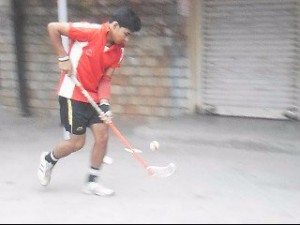 Members should know my feelings about off-season hockey... I firmly believe that on-ice games should be taboo during the spring and summer months. At the same time, I truly believe that players still need to continue growing -- in their hockey skills, athleticism and other physical qualities. With that, I think floorball practices and games would be awesome for hockey players during their off-season.
 To preface these drills, I've already pictured different ways I'd setup some of them on the ice, and I might even use different kinds of setups, to either end with a shot on-goal or not. In some dribbling drills, I might have two groups running in one end zone, and another two working at the far end. With enough players, two more stations could run in neutral ice.
 Can you think of other ways a player has to confront a defender? I surely can. Actually, one idea that came to mind quickly is for a player to kick the puck out to one side a few times through, and then kick it out to the other side for awhile.
 When the basketball players went to three lines of separate attackers, I thought the skills our hockey players worked on in the first two segments would fit well here, too. For awhile, a hockey coach could designate that an attacker execute a spinarama towards the outside from the two outer lines, with the guy in the middle doing a different attack move. Players could shoot quickly on a goalie-less net, and then go to a different line.
 There are a couple of drills in the middle of this video that didn't spart any fresh hockey drill ideas. At the same time, as I watched them, I thought back to times I've seen pretty good high school players miss scoring opportunities because the pass to an open shooter was too far off the mark. I mean, a guy was all set to blast one into an open net, and then the pass arrived in a location that prevented the shooter from making a bang-bang play. For that reason, we coaches have to constantly remind our players to make passes right in a potential shooter's wheel house.
 I think on the drill where the players are shooting over the coach's head, our hockey shooters could be using a coach as a screen for a shot off to one side.
 The coach constantly reminded her players to call for the ball, and we have to stay on our players to call for the puck.
When the coach mentioned that b-ball people focus a lot on ballhandling nowadays, I was thinking about that talk
The coach constantly reminded her players to call for the ball, and we have to stay on our players to call for the puck.
When the coach mentioned that b-ball people focus a lot on ballhandling nowadays, I was thinking about that talk