As CoachChic.com members know, I love working with players on their puckhandling skills. And, what I see as a major part of a skater's game is the need to develop certain puck protection moves (one reason I'm tackling this topic for at least the third time). Also, since this area of play takes a while to master, and because it can be developed both off and on the ice, it makes sense to work on developing puck protection moves during the spring and summer months.
-- Dennis Chighisola
Puck Protection Moves
I think the funny thing is that some hockey folks believe that puck protection moves come naturally to the players. And, from a distance, it may appear that way -- mainly because a top young player or two has figured it out on his own. In reality, though, an entire squad needs to be taught these skills, with goaltenders included right along with the skaters. Now, to start things off here... The inline player in red (off to the right) should be anticipating the approach of a nearby checker in white. Ya, "anticipation" is important in our sport, and thinking about shifting the puck to protect it has to always be on a puckcarrier's mind.
Do all of our players instinctively think like this? Naw -- as I suggested above, it's likely only a few sharper kids will figure it out on their own.
What they'll figure out -- and what we coaches have to help everyone else with -- is the need to shift the puck far away from an oncoming checker, and also place the body between the puck and the checker. And, in order to get the puck as far away from that checker as possible, the puck needs to be extended far out in the one hand that's away from the opponent.
Now, to start things off here... The inline player in red (off to the right) should be anticipating the approach of a nearby checker in white. Ya, "anticipation" is important in our sport, and thinking about shifting the puck to protect it has to always be on a puckcarrier's mind.
Do all of our players instinctively think like this? Naw -- as I suggested above, it's likely only a few sharper kids will figure it out on their own.
What they'll figure out -- and what we coaches have to help everyone else with -- is the need to shift the puck far away from an oncoming checker, and also place the body between the puck and the checker. And, in order to get the puck as far away from that checker as possible, the puck needs to be extended far out in the one hand that's away from the opponent.

 The adjacent photos show exactly what I just described -- with a puckcarrier tossing the puck far out to the side away from the checker, and controlling the puck with just the one hand. I've flipped the photos for my members' sake, so that it's easily seen how a puckhandler must be adept at carrying the puck in either hand -- be it their dominant one or not.
However, since these things don't necessarily come naturally to our players, I've developed a number of simple drills to encourage basic puck protection moves:
The adjacent photos show exactly what I just described -- with a puckcarrier tossing the puck far out to the side away from the checker, and controlling the puck with just the one hand. I've flipped the photos for my members' sake, so that it's easily seen how a puckhandler must be adept at carrying the puck in either hand -- be it their dominant one or not.
However, since these things don't necessarily come naturally to our players, I've developed a number of simple drills to encourage basic puck protection moves:
Drill 1 - I was able to do one drill in the driveway with my grandson... Going kinda slomo, he'd handle a ball in front of me, and then turn away from me as I approached or reached with my stick. Right there, he was beginning to develop the instincts or reactions to protecting the puck as this "bad guy" tried to poke at it.
I next told him to try grabbing my stick with his free hand, so that I couldn't get to the puck. Grabbing my stick isn't an ultimate aim, but it does help a player gain control of the situation.
In that sort of atmosphere, it's easy for a dad or granddad or coach to gradually help build a young player's confidence in his puck protection moves, including using one hand and then the other.
Drill 2 - The beauty of the first drill is that a player is somewhat confined by the driveway and being in shoes. That form of practice should ultimately be brought to the ice, however, with the coach trying to find other ways to slow things down. What I've done is ask my puckhandlers to stay in one small areas if they want to get better at these skills, and most kids have done okay with that.
Of course, instead of a coach working with the players, I'd have my players work in pairs, and then take turns -- as puckcarriers or checkers -- maybe every 30-seconds or so.
Drill 3 - In the next drill, I put 5 players at each face-off circle. Three of my kids will puckhandle slowly around the outside of the circle, while two players will act as stationary checkers as they stand inside the circle -- one checker on each side.
As skaters circle clockwise, they'll shift the puck far out to the left hand as the nearby checker pokes towards them. They'll also use the inside/right hand to fight off the checker's stick. The skaters get to relax for a few glides until they repeat their puck protection moves against the next checker.
And, of course, players will need to eventually skate counterclockwise, and also switch roles as checkers and puckhandlers.
 Drill 4 - This last drill is really more a game of keepaway, done at a game-like speed, and in a larger area.
I encourage my kids to work on their puck protection moves as much as possible here, because there can be a tendency for them to worry more about other things once they're off on their own.
Okay, one more thing... A lot of players -- and I'm talking about older, better ones, too -- often think they're doing something they're not.
And, in this regard, the success of a player's puck protection moves all boil down to his placing his body between the puck and the checker.
The player in the nearby photo seems to be doing exactly that... Can you see it?
On the other hand, a lot of players believe they're protecting the puck just because they're holding it in the opposite hand. What happens to those who lose the puck, though (like in Drill 3), is that they actually carry the puck out in front of their bodies, and don't really hide or protect it off to the side at all.
*
Here are a pair of older posts that should help even more:
puck protection moves

 I have one child who is competitive and individually talented. Certainly the best skills player on the team. But he doesn't play a team game, I'm trying to figure out how to teach him to trust his teammates, pass the puck and spread out.
 I'm not exactly sure where the coach's young 7- and 8-year old kids are but, I've held "timed attack plays" to encourage teamwork among my players.
 What I created -- almost a year ago -- was a "Facebook Group" that's geared exclusively towards "
 As for the new hockey drill options group -- over on Facebook, here's how I see it helping you...
 I grabbed the pic to the right as an example of what I'm talking about. Actually, all three players -- the puckcarrier and the two defenders have their eyes down and they're looking at the puck. And, while that might get the attacker killed, focusing too much on the puck ought to get the defenders permanent seats on the bench. Don't get me wrong: it's okay for a defender to use split vision to simultaneously poke at the puck. What one can't do is only focus down on the puck, thus looking foolish.
 In yet another screenshot I happened to capture, the last defender is getting turned inside-out and backwards, having initially looked down at the puck. You'll have to go back and watch the video (at the .43 mark) to see how badly that defenseman really looked. What that play really amounts to is three white defenders not doing a single thing to prevent a lone attacker from scoring the goal.
 In yet another freeze frame, we catch three defenders out-manning two attackers, and still ending up on the short end of things. If you recall, the dark attacker here walks away from the crowd, then comes right back to rip a wrister through a screen and into the net. In each case -- this one and in many others in the video, the defenders could have grabbed their own man, and shut down the attack.
 - Games of keepaway in small and large areas are a lot like a powerplay, and these can be done as a 2 on 1, 3 on 1, 3 on 2, etc.
 A simple example:
 The main idea of that WakeBoard device was to have a player move in all sorts of unbalanced postures while simultaneously tossing around a weight of some sort.
 Don't get me wrong about what I just said, because perfecting the basics is a really good thing. I want perfect execution as my players perform their roles within our breakouts. I'm a stickler on such things -- as in clean handling of the puck, smart and high percentage skating routes, making good passes and catching any pass within reach.
 To the right is a rough alignment for an Umbrella powerplay, although my "out of sight, out of mind" philosophy will work with any setup.
 Like a lot of things I teach in special areas of our game, I think they tend to spill over and help players in their overall play. Some of my better players have put the "look away" move into their attack, and some have used the "out of sight, out of mind" thinking, too.
If anything, I hope I've planted the seeds here -- for coaches, player parents and adult players -- about incorporating some foolery in the game's X's and O's.
Like a lot of things I teach in special areas of our game, I think they tend to spill over and help players in their overall play. Some of my better players have put the "look away" move into their attack, and some have used the "out of sight, out of mind" thinking, too.
If anything, I hope I've planted the seeds here -- for coaches, player parents and adult players -- about incorporating some foolery in the game's X's and O's.
 I have several really high level posts and videos within this site -- including "
 Just above, I was kinda referring to moving primarily on a straight line -- ahead, backwards, to the left and to the right. Of course, such reactions also involve cross-overs in both directions, and while skating forward and backward. Reading stuff put out by other gurus, I get the impression they believe that power in these turns is supreme. I feel quite a bit differently -- again, because I believe quickness is the biggest need in a transition game.
 It should also necessarily follow that the puck has to move in four different directions as we look to fool and elude enemy defenders. That means a player has to be proficient at dribbling the puck from side to side, and from forward to backward.
 Also like skating, a hockey player has to be able to hug the puck and pull it around both ways in a circle.
 Ya, beyond a point... Of course, standing nice and balanced is a good way to learn a shooting motion. What's wrong, though, is that hockey isn't played like that. No, the top scorers in our game can pull the trigger while in off-balanced positions, while being mauled by a defender, or even while being down on a knee or two.
 Ya, the basketball point guard. Every time I watch a b-ball game, the point guard position reminds me of a hockey playmaker, and such a player also reminds me a lot of the guy I like running my powerplay. No matter, all of these players need great vision, moving with the ball or puck as they survey the area ahead for enemy players and open teammates. So, it's the same thing in our game as it is in basketball or soccer or lacrosse, huh? Ya, and in our sport, on-ice hockey vision is key to advancing the puck up-ice and towards the enemy goal.
 I know I haven't provided a lot of advice here -- other than what's contained in the two short videos, but the most important thing I'd like to leave members with today is a mental picture of something... I mean, whether it be a basketball point guard or one of our hockey players, please envision a player moving with a ball or puck, scanning the area ahead, moving, scanning, moving, scanning... Neither player can survive with tunnel vision, but he instead needs to be able to take in a wide field, and constantly assess the safest way to advance the ball or puck.
Lastly, if you click here -- on
I know I haven't provided a lot of advice here -- other than what's contained in the two short videos, but the most important thing I'd like to leave members with today is a mental picture of something... I mean, whether it be a basketball point guard or one of our hockey players, please envision a player moving with a ball or puck, scanning the area ahead, moving, scanning, moving, scanning... Neither player can survive with tunnel vision, but he instead needs to be able to take in a wide field, and constantly assess the safest way to advance the ball or puck.
Lastly, if you click here -- on  I'm sure members realize that there are two sides to any drill -- the scientific side and the artistic side. So, right up front, I'd have to say that "
 One has to do with
 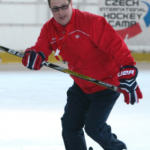 PS: I know I spent all my time on defining the meaning/s behind that video, and none so far on the content. As far as that goes, I hope member coaches take note of the way those drills mostly represent small segments of attacking the goal. I don't think I need to explain those drills, except to say that Oldrich seems to assemble tons of ideas for the viewer -- on numerous ways to practice shooting or making a move on the goaltender.
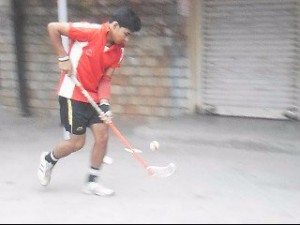 Members should know my feelings about off-season hockey... I firmly believe that on-ice games should be taboo during the spring and summer months. At the same time, I truly believe that players still need to continue growing -- in their hockey skills, athleticism and other physical qualities. With that, I think floorball practices and games would be awesome for hockey players during their off-season.
 To preface these drills, I've already pictured different ways I'd setup some of them on the ice, and I might even use different kinds of setups, to either end with a shot on-goal or not. In some dribbling drills, I might have two groups running in one end zone, and another two working at the far end. With enough players, two more stations could run in neutral ice.
 Can you think of other ways a player has to confront a defender? I surely can. Actually, one idea that came to mind quickly is for a player to kick the puck out to one side a few times through, and then kick it out to the other side for awhile.
 When the basketball players went to three lines of separate attackers, I thought the skills our hockey players worked on in the first two segments would fit well here, too. For awhile, a hockey coach could designate that an attacker execute a spinarama towards the outside from the two outer lines, with the guy in the middle doing a different attack move. Players could shoot quickly on a goalie-less net, and then go to a different line.
 There are a couple of drills in the middle of this video that didn't spart any fresh hockey drill ideas. At the same time, as I watched them, I thought back to times I've seen pretty good high school players miss scoring opportunities because the pass to an open shooter was too far off the mark. I mean, a guy was all set to blast one into an open net, and then the pass arrived in a location that prevented the shooter from making a bang-bang play. For that reason, we coaches have to constantly remind our players to make passes right in a potential shooter's wheel house.
 I think on the drill where the players are shooting over the coach's head, our hockey shooters could be using a coach as a screen for a shot off to one side.
 The coach constantly reminded her players to call for the ball, and we have to stay on our players to call for the puck.
When the coach mentioned that b-ball people focus a lot on ballhandling nowadays, I was thinking about that talk
The coach constantly reminded her players to call for the ball, and we have to stay on our players to call for the puck.
When the coach mentioned that b-ball people focus a lot on ballhandling nowadays, I was thinking about that talk  “First off, everybody in the league can shoot the puck,” Canadiens goalie Ben Scrivens said after Thursday’s morning skate. “Fans watch games and they say: ‘Aw, this guy can’t shoot the puck.’ Everybody in the league can shoot the puck — they can shoot the puck hard and, within reasonable expectations, they’re all pretty accurate, first line to fourth line. The difference between the elite shooters is how effectively they can get releases off. The guys who can pick their spots without giving any tells to the goalies about where they’re putting it. The less movement you can have pre-shot.
 Oh, on my title choice, "creating older hockey goal-scorers"... I called it that to distinguish this from my long ago article and video called "
 Let me say that again (or let
  When it comes to seeing the puck, it should make sense that screening the goaltender can really help. Members might immediately think about putting a guy in front of the goaler to block his view -- and that's good. But a puckcarrier can also use other players on the ice as momentary screens, thus pulling the trigger without the goaltender even knowing it.